
Olympia Previous-Resident Sources
The useful starting source depends on the period. Recent work begins with the county parcel and deed systems. Older Olympia house research shifts toward State Library directories, released federal census schedules, Sanborn maps, newspapers, and archives. No exact EagleWeb start year was confirmed, so the offline route matters.
| Source | Years covered | Where held | What it can show |
|---|---|---|---|
| Recorded deed index | Online start not confirmed; older county material survives | Auditor, EagleWeb, office, archives | Grantor, grantee, legal description, deed chain |
| First Record Book | 1852-1857 | Digital Archives | Early deeds, probate, marriages, proceedings |
| Olympia city directories | 1872-2013, with gaps | WSL, Timberland, HeritageQuest | Names, addresses, possible household clues |
| Polk indexed run | 1902-03, 1906, 1909 | Digital Archives and WSL | Indexed names or businesses; Soundex search |
| Telephone books | 1922-2010, with gaps | WSL and library holdings | Listed telephone and address |
| Federal census | Released schedules under the 72-year rule | NARA and library databases | Household, age, relation, birthplace, work |
| Sanborn maps | 1884-1950s among cited runs | OHS, LOC, WSL, Timberland | Footprint, use, materials, some street numbers |
| Permits and probate | Current portal or case-specific | SmartGov and County Clerk | Building work, estates, heirs, property notices |
Start with the source nearest the target date. Then move one step older and one step newer. A directory listing between deeds can identify a listed occupant, while a census can reveal the larger household.
Fix the Olympia Address First
The current street string may not match an old record. Olympia records distinguish the situs address, tax-mail address, and legal description. Historic directory labels can also include places outside present city limits. No verified citywide renumbering year was found, so never assign one.
Open A+ Parcel Search and capture the parcel number, legal description, situs address, owner, sales clues, ZIP, and city status. If an earlier deed lacks the current number, search its lot and block, plat, survey, map case, or metes-and-bounds description. Metes and bounds identifies land through measured courses, distances, and landmarks.
The present parcel is a launch point, not proof of previous residents. Mailing information may lead to a trust, estate, business, or address outside Thurston County.
Reverse Olympia’s Deed Chain
The Thurston County Auditor indexes deeds and many related land records. A grantee receives the interest; a grantor gives or transfers it. The chain of title is the linked sequence of those transfers for the same land.
- Use A+ to identify today’s assessed owner, parcel number, and full legal description.
- Search EagleWeb for that owner as grantee, or use parcel and document details. Find the latest purchase deed.
- Record the grantor, date, Auditor File Number, and legal description. Confirm the land, not just the surname.
- Search that seller as a grantee in an older deed. Narrow by document type, date, parcel, plat, or spelling variant.
- Repeat until the web index stops. Continue through Auditor office viewing, a mailed copy request, Southwest Regional Archives, State Library, or the FamilySearch catalog.
The online image is a standard copy, not a certified one. The Auditor charges $1 per photo-copy page and $3 for the first certified page plus $1 for each added page. Written requests go to Auditor Attn Copy Request, 3000 Pacific Ave SE, Olympia WA 98501. Phone and email requests are also documented.
- Grantor
- The person or entity transferring a recorded interest.
- Grantee
- The person or entity receiving that recorded interest.
- Chain of title
- The connected run of transfers for the same land.
- Legal description
- The formal land wording used to bridge address or parcel changes.
Olympia’s Territorial Record Layer
The Thurston First Record Book pushes a previous residents search into the territorial era. The digitized volume covers 1852 through 1857 and spans 529 pages. Its 2,150 index records combine deeds, probate, marriages, county proceedings, and other matters rather than separating them into modern portals.
Search results can fail for reasons that have nothing to do with a missing person. Names may use two initials. A name spread across several pages is indexed on the first page. Partnerships may appear with an ampersand in one place and the word “and” in another. Old legal descriptions can cite landmarks that disappeared. Browse the three published page ranges, inspect nearby leaves, and test surname, spelling, or initial variants before abandoning the lead.
A deed or probate entry can tie a name to property, but it may not prove that the person lived there. The value lies in bridging an old grantor to a later directory, map, census, or estate record. Save the scanned page number and indexed role so another researcher can retrace the finding.
Pair Olympia Directories and Census
Ownership is only half the question. Olympia city directories begin with a State Library-listed 1872 volume and continue through 2013 in long runs with gaps. Released census schedules name households at ten-year points. Together, they can test who lived here before even when the occupant did not own the parcel.
- Choose the nearest directory year before and after the target date.
- Check both the name section and any address or classified section. Copy initials, spelling, address, and household notes exactly.
- Compare the closest released census year: 1900, 1910, 1920, 1930, 1940, or 1950 as appropriate.
- Add an obituary, legal notice, deed, permit, or probate file that shares the same name and time.
- Mark absences as unresolved. A missing volume, unlisted phone, suburb label, or spelling variant can mimic a move.
The Olympia directory-book research gives the full year runs and access choices. HeritageQuest requires a Timberland library card, and Ancestry Library Edition is available only in the library.
Search Indexed Olympia Residents
The Digital Archives Polk collection contains 6,210 indexed Olympia and Thurston County records for 1902-03, 1906, and 1909. Search Party Last, First, and Middle, try the Soundex option for names that sound alike, or browse the series. Volunteers transcribed the index, so compare the result with the scan or original.
The indexed collection shown below covers only a small part of Olympia’s long on-site directory run.
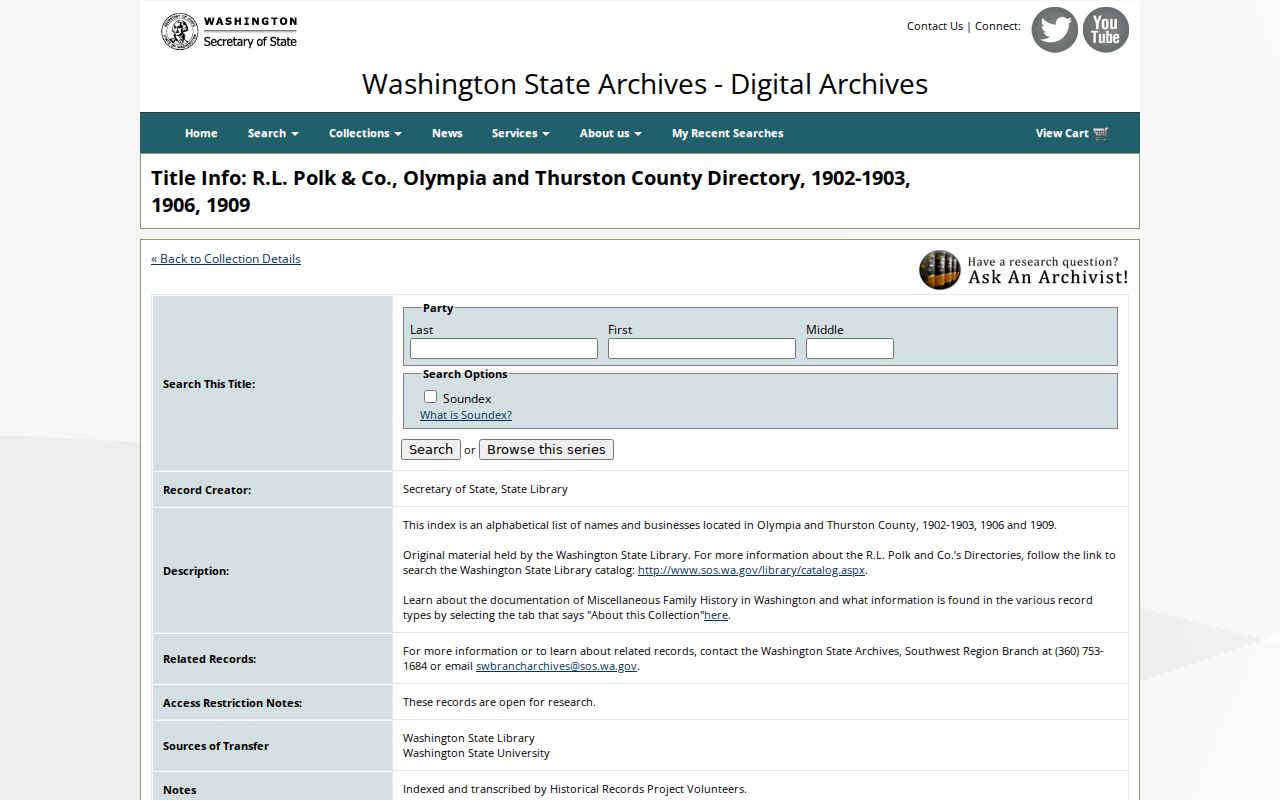
Use the digital index for discovery, then save the title, year, page or scan identifier, and whether the item is a person, household, business, or institution.
Date an Olympia Building
Sanborn maps show the built setting around past residents. Olympia Historical Society overlays cover 1884, 1891, 1908, and 1924. The Library of Congress has an eight-sheet November 1888 Olympia set, while Washington State Library microfilm spans 1884 into the 1950s.
Compare map years for changes in footprint, stories, construction material, use, lot lines, and street numbers. A building can appear, expand, change use, or disappear between editions. Yet a Sanborn sheet is not a household list. Pair it with a directory, census, deed, or newspaper.
The Olympia Historical Society research resources connect maps with address-based local history.
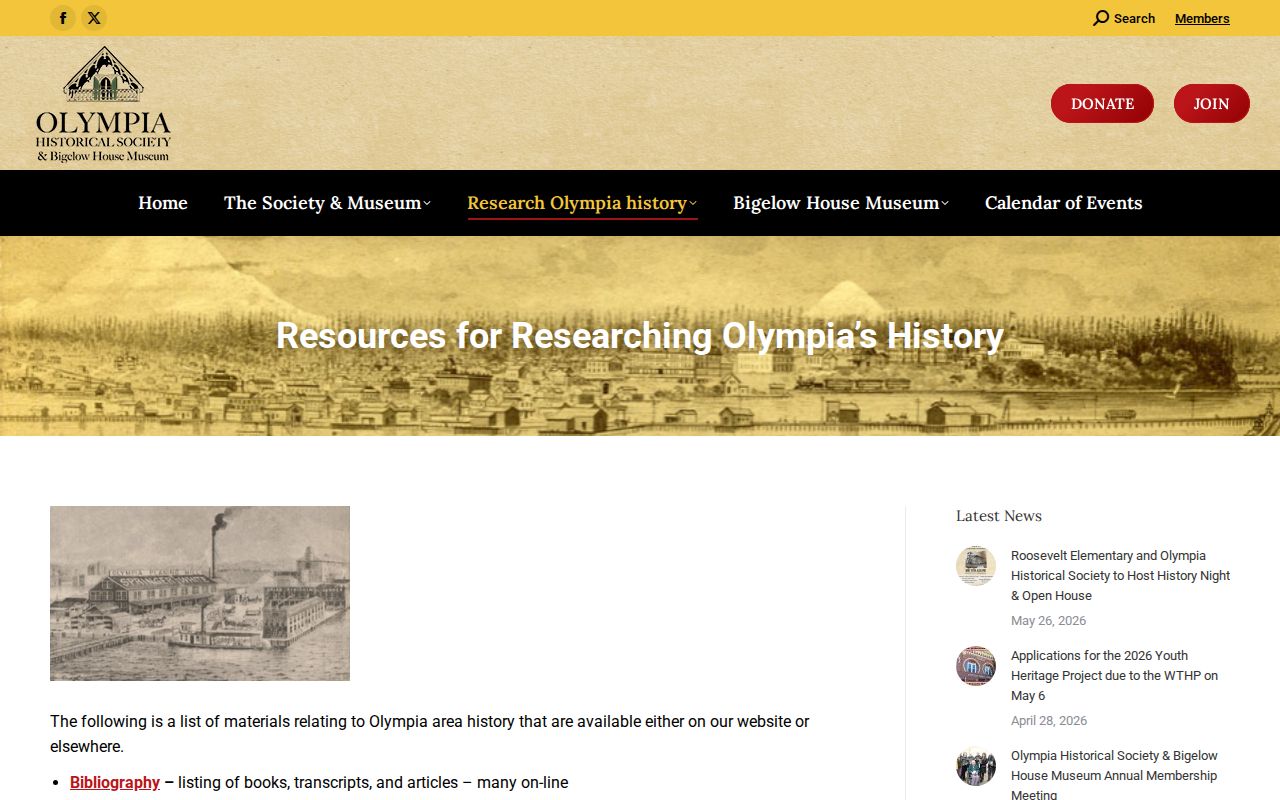
The map layer is especially useful when an old street number or vanished feature makes a modern address search fail.
Use Olympia’s Archive Network
Olympia’s historic-property research guide points to several access channels. Olympia Timberland Library, 313 8th Ave SE, holds clipping files, city directories, genealogy resources, maps, and a microfilm reader. Staff can help locate a specific obituary or article, but generally do not perform broad research. The branch lists 360-352-0595 and asklib@trl.org.
Washington State Library at 6880 Capitol Blvd S in Tumwater holds directories, histories, biographical files, census and death sources, photographs, and manuscripts for on-site use. Its Ask-a-Librarian service can perform a limited, specific lookup. Southwest Regional Archives at 1129 Washington Street SE can help with assessor field books, grantor and grantee records, and other archival county material. Call ahead, since access notices change. Thurston County Clerk customer-service counters closed in January 2026, although lobby public terminals remain available from 8 a.m. to 4 p.m.
For newspapers, Timberland offers NewsBank access including The Olympian from 2001 to today, plus other Washington coverage. HeritageQuest includes census and directory material for library-card users. Ancestry Library Edition is available only inside the library. The library's current page says HeritageQuest and Sanborn access runs through December 31, 2026, so verify licensing before relying on remote access. Microfilm fills part of the older gap and patrons may bring outside film.
A request works best when it names one person, address, record type, and year range. Bring the legal description or parcel number when asking about land. For a newspaper search, provide an event date and spelling variants. These details let staff identify a shelf volume, film reel, archival series, or custodian without being asked to conduct open-ended family research.
Bridge Olympia Resident Gaps
When the deed trail stalls at an estate or old owner, search probate, obituaries, legal notices, and naturalization records. A probate file can name a decedent, representative, heirs, attorneys, property, and notices, subject to sealing and redaction. The Thurston County Clerk and court request route supplies complete file access where allowed.
SmartGov permits can date construction or remodeling. They may name an applicant, owner, architect, contractor, or agent, so the name is not automatic proof of occupancy. Newspapers can place a family at an address through an obituary or legal notice. Naturalization indexes add another identity check for some residents.
End with a documented trail, not a guess. Note each source date and label uncertain links. A previous residents conclusion is much stronger when a directory and census agree, or when a deed and probate file share the same land description.
Lawful use. Research Olympia past residents for family history, house history, estates, and personal curiosity. Never use living-person information to stalk, harass, track, intimidate, or harm anyone.